Thursday

"Tax collectors and prostitutes are entering the kingdom of God before you."


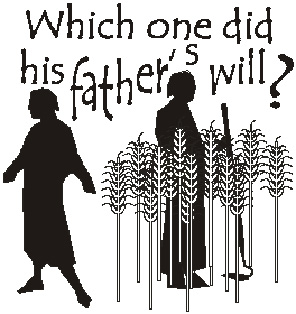
The parable for this Sunday, Sept. 28, 2014 (26A) was one of three parables Christ spoke in His last days. They are known in history as the Parables of Rejection. This day's Gospel was the first and shortest of the melancholy three. This Sunday we are also treated to one of the most beautiful passages about Jesus in the entire Bible. It is found in the Letter of St. Paul to the Philippians.

Sunday Readings' Discussion Questions

Twenty-sixth Sunday in Ordinary Time, Sep. 28, 2014 (26A)

From the
Center for Liturgy at Saint Louis University

Sunday Mass Readings

Podcast of the Readings 
Video of Reflections on Readings
Lecturas y Comentarios 
New American Bible
Prayer of the Hours
BQ: Why Don't you Read the Bible?

--------------------------------------------
Questions on Sunday's Readings for use by discussion groups,
prayer groups, or for individual prayer.
--------------------------------------------

First Reading

Book of the prophet Ezekiel, Chapter 18, Verses 25-28

1. If you turn away from wickedness you are turning toward God. One spiritual writer calls turning toward God “conversion.” Do you think you are converted just once or do you do it many times in your lifetime? If so, why? If not, why?

2. The Lord is quoted as saying, “When someone virtuous turns away from virtue to commit iniquity, and dies, it is because of the iniquity he committed that he must die.” Does such iniquity affect the entire Mystical Body of Christ? What about a member doing good deeds?

Responsorial Psalm

Psalm 25: 4-5, 8-9, 10, 14

1. This Psalm can be likened to an Act of Contrition by our psalmist. By praying this Psalm before God, are you led to seek a remission of your sins? Explain.

2. We may have sympathy for the author of this Psalm (David). Can you identify with the psalmist, as he seeks God's mercies and confesses his sins? Talk about your own approach to seeking God's forgiveness.

Second Reading

Letter of St. Paul to the Philippians, Chapter 2, Verses 1-11

1. St. Paul tells us to have the same attitude that is also in Christ Jesus. In this reading what words describe his attitude? Can you act that way? What are Jesus’ deeds as described in the reading? Can you do such deeds yourself?

2. The second part of the reading (which is left out in the alternate version, which a parish may choose), beginnign with the words “though he was in the form of God,” contains the entirety of Christian, Catholic belief. Do you understand what it is saying? Can you put it in your own words?

Gospel
According to Matthew, Chapter 21, Verses 28-32

1. Using the idea of “conversion” (see the first question on the first reading), discuss the first son and the second son. Which one needed to change and turn toward his father? Are you presently in need of conversion in any area of your life? What counts in building community, saying some good words, or actually doing some good deeds? At which one are you better, words or deeds?

2. “When John came to you in the way of righteousness, you did not believe him,” Why didn’t the chief priests and the elders believe John the Baptist? Is it hard to think in new ways? Is it hard for you?

Online Sunday Bible Study Group
Please share below your reflections on the Sunday Readings. May we be blessed by God's words as reflected in your thoughts and experience-sharing. 
--


"If your brother sins against you..."


In the Gospel for this Sunday, Sept. 7, 2014 (23), Matthew adapts sayings of the historical Jesus to address the new situation of an established local church in need of due process to handle difficult problems. He compels us to consider the essential elements in the process of forgiveness among members of the Church community.

Sunday Readings' Discussion Questions

Twenty-third Sunday in Ordinary Time, Sep. 7, 2014 (23A)
From the
Center for Liturgy at Saint Louis University

Sunday Mass Readings
Podcast of the Readings 
Video of Reflections on Readings
Lecturas y Comentarios 
Prayer of the Hours
BQ: What do you think is the Worst Sin?

--------------------------------------------
Questions on Sunday's Readings for use by discussion groups,
prayer groups, or for individual prayer.
--------------------------------------------
First Reading
Book of the prophet Jeremiah, Chapter 20, Verses 7-9

1. Jeremiah couldn’t ignore the call to prophecy even though it brought him much suffering. Who today speaks out about injustice and is met with mockery? What social or economic structure of oppression would you like to transform so badly that you can’t keep quiet about it?

2. Would your first inclination be to avoid suffering if possible? Is it humanly possible to avoid all suffering? What are some good “by-products” of suffering?

Responsorial Psalm

Psalm 63: 2, 3-4, 5-6, 8-9

1. Our psalmist says his flesh pines and his soul thirsts for God. Have you also experienced a longing for God that is akin to being lifeless and without water? Explain.
2. The psalm is written by a man who truly loves the Lord, and yet even our psalmist experiences periods of separation from God. Do you believe that God reaches out even to those who do not believe in Him, and that their souls too are thirsting for the Lord? Give an example.

Second Reading

Letter of St. Paul to the Romans, Chapter 12, Verses 1-2

1. “For who has known the mind of the Lord?” How good are you at second-guessing God? Can you always figure out ahead of time where God is leading you, or what God is doing in your life?

2. Look at at the rear-view mirror at the highway of your life. Can you see where God was on the road with you?

Gospel
According to Matthew, Chapter 16, Verses 21-27

1. “Lose your life for my sake and find it” What does Jesus mean when he says you will “find” your life? How does the “finding” apply to this life as well as the next?

2. You cannot take your money and possessions with you when you die. If you “lose your life” in love for others, does that give you something to take with you? Is it the love in your heart that goes with you when you die?

Online Sunday Bible Study Group
Please share your reflections on the Sunday Readings. May we be blessed by God's words as reflected in your thoughts and experience-sharing. 
--

"Get behind me, Satan!"


Last week we heard in our Gospel reading about Peter’s spontaneous profession of faith, “You are the Christ, the Son of the Living God.” This was followed by Christ’s great mandate to Peter and his successors, “Upon this rock I will build my Church.” And yet here we are with the immediately following text where Jesus calls Peter a stumbling block and says, “Get behind me Satan” What has happened?

Sunday Readings' Discussion Questions
Twenty-second Sunday in Ordinary Time, Aug. 31, 2014 (22A)

From the
Center for Liturgy at Saint Louis University
Sunday Mass Readings
Podcast of the Readings 
Video of Reflections on Readings
Lecturas y Comentarios 
Prayer of the Hours
BQ: What do you think is the Worst Sin?

--------------------------------------------
Questions on Sunday's Readings for use by discussion groups,
prayer groups, or for individual prayer.
--------------------------------------------

First Reading
Book of the prophet Jeremiah, Chapter 20, Verses 7-9

1. Jeremiah couldn’t ignore the call to prophecy even though it brought him much suffering. Who today speaks out about injustice and is met with mockery? What social or economic structure of oppression would you like to transform so badly that you can’t keep quiet about it?

2. Would your first inclination be to avoid suffering if possible? Is it humanly possible to avoid all suffering? What are some good “by-products” of suffering?

Responsorial Psalm

Psalm 63: 2, 3-4, 5-6, 8-9

1. Our psalmist says his flesh pines and his soul thirsts for God. Have you also experienced a longing for God that is akin to being lifeless and without water? Explain.

2. The psalm is written by a man who truly loves the Lord, and yet even our psalmist experiences periods of separation from God. Do you believe that God reaches out even to those who do not believe in Him, and that their souls too are thirsting for the Lord? Give an example.

Second Reading

Letter of St. Paul to the Romans, Chapter 12, Verses 1-2

1. “For who has known the mind of the Lord?” How good are you at second-guessing God? Can you always figure out ahead of time where God is leading you, or what God is doing in your life?

2. Look at at the rear-view mirror at the highway of your life. Can you see where God was on the road with you?

Gospel
According to Matthew, Chapter 16, Verses 21-27

1. “Lose your life for my sake and find it” What does Jesus mean when he says you will “find” your life? How does the “finding” apply to this life as well as the next?

2. You cannot take your money and possessions with you when you die. If you “lose your life” in love for others, does that give you something to take with you? Is it the love in your heart that goes with you when you die?

Online Sunday Bible Study Group
Please share below your reflections on the Sunday Readings. May we be blessed by God's words as reflected in your thoughts and experience-sharing. 
--

"Upon this rock I will build my church."


This Sunday's gospel story places Jesus in Caesarea Philippi and the disciples are just back from their mission of preaching. Jesus asks them who the people think he is. He is measuring the faith-status in the regions around him. All of us at some stage must come to our own Caesarea Philippi. Just as he challenged the disciples, to each of us who are baptized Jesus leans over and whispers, "But YOU...who do YOU say I am?" 

Sunday Readings' Discussion Questions

Twenty-first Sunday in Ordinary Time, Aug. 24, 2014 (21A)

From the
Center for Liturgy at Saint Louis University

Sunday Mass Readings
Podcast of the Readings 
Video of Reflections on Readings
Lecturas y Comentarios 
Prayer of the Hours
BQ: What influence does the Pope have on your personal life?

--------------------------------------------
Questions on Sunday's Readings for use by discussion groups,
prayer groups, or for individual prayer.
--------------------------------------------

First Reading

Book of the prophet Isaiah, Chapter 22, Verses 9-23

1. Discuss ways in which Eliakim is a prototype of the ultimate leader, Christ. And, what does Eliakim have in common with Peter?

2. God says he will fix Eliakim like a peg in a sure spot so he will have a place of honor. The reading is full of similies and metaphors concerning God’s support for him. Besides having a solid faith, what other qualities or virtues do you look for in Church leadership?

Responsorial Psalm

Psalms 138:1-2, 2-3, 6, 8

1. The Psalm's response petitions the Lord,"Do not forsake the work of your hands." Can you identify with this verse? In what way do you believe you are the work of His hands?

2. Our psalmist is grateful that the Lord has built up strength within him. Do you also believe that your prayer time with the Lord can become a source of strength, even though you may have approached the Lord from a position of weakness? Explain.

Second Reading

Letter of St. Paul to the Romans, Chapter 11, Verses 33-36

1. “For who has known the mind of the Lord?” How good are you at second-guessing God? Can you always figure out ahead of time where God is leading you, or what God is doing in your life?

2. Look at at the rear-view mirror at the highway of your life. Can you see where God was on the road with you?

Gospel
According to Matthew, Chapter 16, Verses 13-20

1. Jesus hears who “other people” say he is, but he wants to know who his disciples think he is. How would you answer his question, “Who do you say that I am?”

2. “I will give you the keys of the kingdom of heaven, and whatever you bind on earth will be bound in heaven, and whatever you loose on earth will be loosed in heaven.” Do the keys refer to Peter’s authority to legislate or interpret the Law? “And upon this rock I will build my church.” Who is building the church, Christ or Peter? How could/do you help “build” the church?

Online Sunday Bible Study Group
Please share below your reflections on the Sunday Readings. May we be blessed by God's words as reflected in your thoughts and experience-sharing. 
--


"O woman, great is your faith!"


These Sunday Readings for August 17, 2014 for fare among the most difficult passages in the Bible. St. Paul seems to be talking in circles when he talks to the Romans. While in the Gospel, Jesus appears to be cold, even callous to the woman crying out for help. We need to spend some time trying to understand these readings so we can profit from the Church's message to us today.

Sunday Readings' Discussion Questions

Twentieth Sunday in Ordinary Time, Aug. 17, 2014 (20A)

From the
Center for Liturgy at Saint Louis University

Sunday Mass Readings

Podcast of the Readings 
Video of Reflections on Readings
Lecturas y Comentarios 
Prayer of the Hours
BQ: Can non-Catholic people go to heaven?

--------------------------------------------
Questions on Sunday's Readings for use by discussion groups,
prayer groups, or for individual prayer.
--------------------------------------------

First Reading

Book of the prophet Isaiah, Chapter 56, Verses 1, 6-7

1. In this reading God offers saving mercy to all people. If there were a continuum with one end being exclusive and the other aggressively inclusive (with passively non-exclusive somewhere in the middle) where would you find yourself?

2. Could inclusiveness be improved where you work, live, play, pray? How? What can you do to improve an exclusive situation?

Responsorial Psalm

Psalms 67:2-3, 5, 6, 8

1. This Sunday's Psalm response is 'O God, let all the nations praise you.' What does this verse convey about the universal appeal of our faith?

2. Our psalmist petitions God to bless us and 'let his face shine upon us.' In what way do you feel blessed by the Lord, and what does it mean to you to let the Lord's face shine upon you?

Second Reading

Letter of St. Paul to the Romans, Chapter 11, Verses 11-15, 29-32

1. “The gifts and the call of God are irrevocable.” According to St. Paul’s statement, will God ever change God’s mind and stop loving you? “Even if we are faithless he is faithful, because he cannot deny himself.” (2 Tim. 2:13) Explain this quote in the light of the first quote.

2. What are the implications of these scripture passages for you?

Gospel

According to Matthew, Chapter 15, Verses 21-28

1. What virtues did the Canaanite woman possess that got Jesus to answer her request? What is it about her statement, “Please, Lord, for even the dogs eat the scraps that fall from the table of their masters.” that made Jesus change his mind and grant her request to heal her daughter? Do you think he could have received an insight about his mission from his Father during this conversation?

2. This woman’s faith broke through some barriers that excluded certain people. What inclusion blockades do you see today that you think need to be broken through?

Online Sunday Bible Study Group
Please share below your reflections on the Sunday Readings. May we be blessed by God's words as reflected in your thoughts and experience-sharing. 
--


Friday

"O you of little faith, why did you doubt?"


In this Sunday's Gospel, Jesus walks on water and asks Peter to do the same. We are assured that the Lord Jesus keeps vigilant watch over each one of us at all times, and especially in our moments of temptation and difficulty. When troubles and danger threaten to overwhelm you, how do you respond? With expectant faith and hope in the Lord's abiding presence, love and care for you?

Sunday Readings' Discussion Questions

Nineteenth Sunday in Ordinary Time, Aug. 10, 2014 (19A)

From the
Center for Liturgy at Saint Louis University

Sunday Mass Readings
Podcast of the Readings 
Video of Reflections on Readings
Lecturas y Comentarios 
Prayer of the Hours
BQ: Is it better to be a lukewarm Catholic or an on-fire Protestant?

--------------------------------------------
Questions on Sunday's Readings for use by discussion groups,
prayer groups, or for individual prayer.
--------------------------------------------

First Reading

First Book of Kings, Chapter 3, Verses 5, 7-129

1. Isaiah was writing for a poor community.What images and ideas in this reading would be of particular interest to them? What does God tell us to do in this reading to share in the abundant banquet of rich fare?

2. What is the food that can satisfy your soul’s deepest hunger?

Responsorial Psalm

Responsorial Psalm: 85:9, 10, 11-12, 13-14

1. Our psalmist commits himself to hearing God's voice. Are you tuned in to the voice of the Lord? How does He speak to you in your daily walk?
2. Our Psalm says that the Lord's salvation is near to those who fear Him, that the Lord is 'glory dwelling in our land.' Do you feel His presence among us, and do you believe your salvation is within reach? Explain.

Second Reading

Letter of St. Paul to the Romans, Chapter 9, Verses 1-5

1. Paul is in “great sorrow and constant anguish” because some of his own people, the Israelites, have not accepted the fact that the Messiah has come. Is this because he wishes the best for them and would even sacrifice himself to help them?

2. How can Paul say, “I could wish that I myself were accursed and cut off from Christ for the sake of my own people, my kindred according to the flesh”? Is it really moral to give away not just you life but your eternal salvation for the sake of others? Or is Paul exaggerating for the sake of emphasis?

Gospel

According to Matthew, Chapter 14, Verses 22-33

1. Peter was walking toward Jesus and doing fine. What caused him to suddenly to sink? What causes you to cancel your “leap of faith?” What do you think would have helped Peter stay afloat? What might help you?
2. After Jesus got into the boat the wind died down. Do you think he can calm your fears the way he calmed the sea?

Online Sunday Bible Study Group
Please share your reflections on the Sunday Readings. May we be blessed by God's words as reflected in your thoughts and experience-sharing. 

 If your parish website is not yet mobile-friendly, we can help. Click here for more information:   http://mobile.parishworld.net
--


Thursday

"Five loaves and two fish are all we have here."


This Sunday's Readings for Aug. 3, 2014 -- the Gospel of the miracle of the multiplication of loaves and fish -- causes us to pause for careful reflection about the serious immigration dilemma we currently face at our borders. This Gospel is so central to the Bible that it is one of the few miracles found in all four gospels. It help us recognize the gifts we have been given and the responsibility we have to give to others.

Sunday Readings' Discussion Questions
Eightteenth Sunday in Ordinary Time, Aug 3, 2014 (18A)
From the Center for Liturgy at Saint Louis University

Sunday Mass Readings
Podcast of the Readings 
Video of Reflections on Readings
Lecturas y Comentarios 
Prayer of the Hours
BQ: Eucharist ? Communion ? Which is it ?

--------------------------------------------
Questions on Sunday's Readings for use by discussion groups,
prayer groups, or for individual prayer.
--------------------------------------------
First Reading
First Book of Kings, Chapter 3, Verses 5, 7-129

1. Isaiah was writing for a poor community.What images and ideas in this reading would be of particular interest to them? What does God tell us to do in this reading to share in the abundant banquet of rich fare?

2. What is the food that can satisfy your soul’s deepest hunger?

Responsorial Psalm

Psalm 145: 8-9, 15-18
1. Our Psalm says that the Lord feeds us and gives us our food in due season. What kind of nourishment are you receiving from the Lord?

2. The Psalm says the Lord is near to all who call upon him in truth. How do you approach the Lord to satisfy your spiritual hunger and answer all your needs?

Second Reading

Letter of St. Paul to the Romans, Chapter 8, Verses 35, 37-39

1. The reading asks us, “What will separate us from the love of Christ.” Does anything separate you completely from those you love? What does communication or the lack of it do for a relationship? Do you communicate with God to keep that relationship close? Whose strength is it that allows nothing to separate you from the love of God?

2. Nothing separated Christ from his love for us, not anguish, or distress, or the sword. Compare this thought with the hungry poor people in the First Reading who are given rich fare to eat and wine and milk. What is the common denominator in these two readings?

Gospel

According to Matthew, Chapter 14, Verses 13-21

1. Feeding 5000 would be a large task for most of us. Are some problems too big to handle? How do you look at “insurmountable” tasks in your own life? What did you think of when you read, “He looked up to heaven and blessed and broke the loaves, and gave them to the disciples?”


2. The people in today’s readings were poor first, then rich with God’s abundant gifts to them. In the wedding feast at Cana, first there was not enough wine, then too much. In Sunday’s Gospel reading they first had no food, and then they collected twelve baskets of leftovers. What is the spiritual meaning of these contrasts?

Online Sunday Bible Study Group

Please share below your reflections on the Sunday Readings. May we be blessed by God's words as reflected in your thoughts and experience-sharing.